RESEARCH
We study how organisational culture shapes the way people manage risk, and how organisations can become effective at learning from feedback and fixing problems before they escalate and cause harm
We call this corrective culture: the shared norms and behaviours that make organisations good at managing risk and uncertainty
Ongoing projects
LEARNING FROM COMPLAINTS
Complaints from patients and the public often reveal risks and safety problems that organisations miss. We study how organisations can analyse and learn from them.
- We developed HCAT, a free tool for analysing complaints that is now used in over 20 countries
- Complaints predicted hospital mortality better than staff incident reports, because patients see problems that staff miss
- We are now testing HCAT-AI, an automated version of HCAT using large language models
- Hannah Bunt is building AI to learn from complaints in finance
- Key papers: Reader et al., 2014; Gillespie & Reader, 2016; Reader & Gillespie, 2021; Gillespie & Reader, 2023

CORRECTIVE CULTURE
Culture can cause accidents and scandals, but it can also be the means of preventing them. We study why organisations fail to fix problems, and what helps them succeed.
- We analysed 54 UK public inquiries into major failures in healthcare, banking, energy, and other sectors
- Every failure showed “problems in dealing with problems”: breakdowns in spotting, understanding, and acting on risk
- We developed the corrective culture model to explain why some organisations correct problems while others let them grow
- At its heart is the corrective loop: problems are identified, interpreted, and acted on. Strong cultures run this loop continuously and at every level, and use it not only to fix problems but to change the factors that cause them.
- Our current work examines how organisations build a strong corrective culture – and how they recover when it has become dysfunctional
- Key papers: Hald et al., 2021; Hald et al., 2023; Hald et al., 2025
UNOBTRUSIVELY MEASURING CULTURE
Surveys often miss the cultural problems that matter most for risk, such as people being silenced or poor standards becoming normal. We use AI to measure culture from naturally generated text produced in organisations.
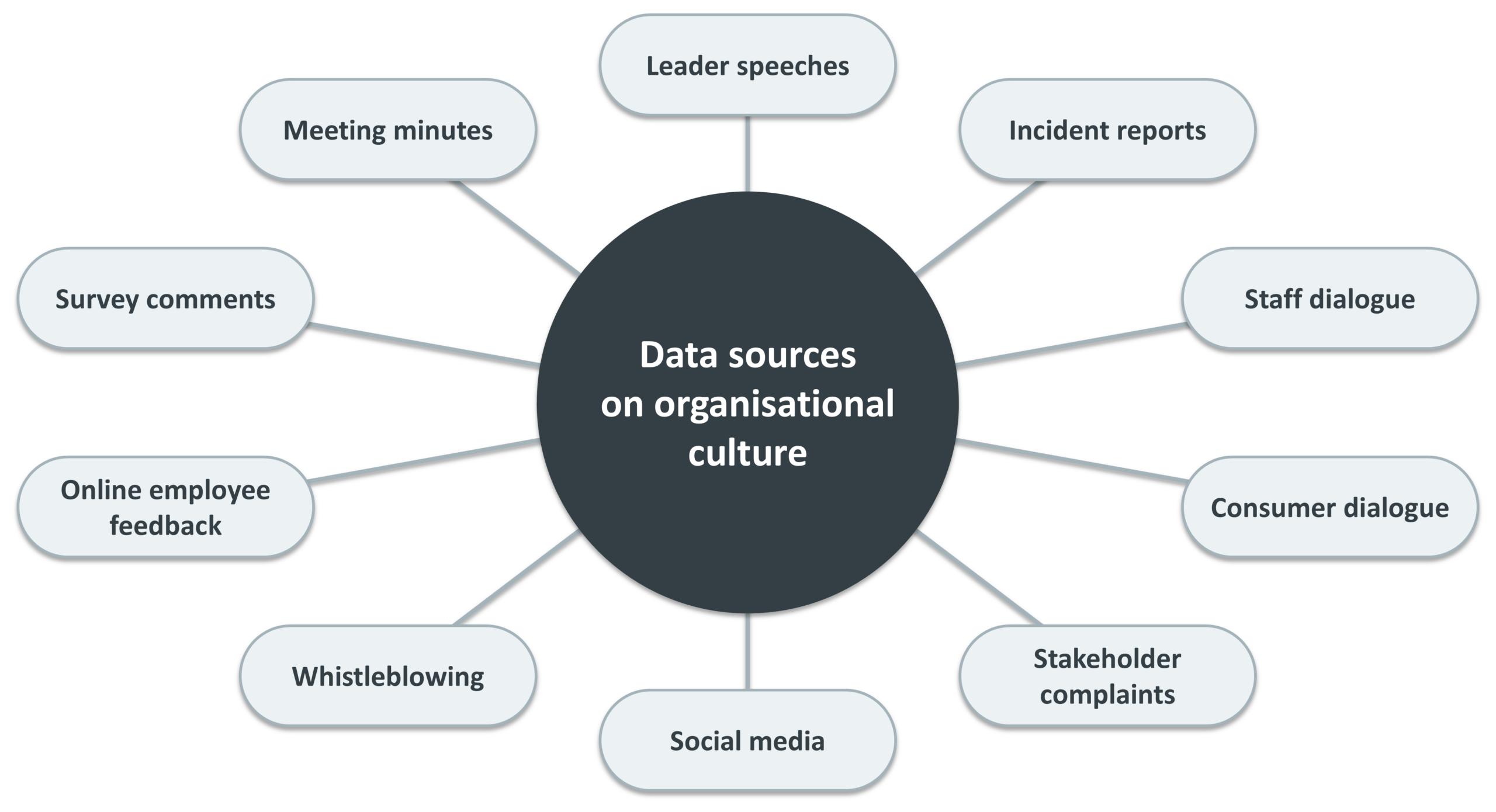
- Our “unobtrusive indicators of culture” draw on employee reviews, complaints, incident reports, and speeches
- They give quantitative scores, and pick out the segments of text that explain them
- Tested in hundreds of European companies and in hospitals, they predicted outcomes such as hospital mortality, corporate scandals, and financial performance
- We now use large language models to analyse live dialogue in the same way
- Key papers: Reader et al., 2020; Reader & Gillespie, 2023; Gillespie & Reader, 2023; Reader & Gillespie, 2024

LARGE LANGUAGE MODELS AND PSYCHOLOGY
Large language models such as ChatGPT, Gemini, and Claude can analyse far more text than any human team. We test how they can be used, reliably and ethically, in research on culture and risk.
- We develop and validate protocols for using LLMs to code qualitative data
- LLMs coded material such as online forums, diaries, and complaints as reliably as trained human coders
- Using LLMs, we measured how hospitals respond to patient-reported safety incidents online, from engaging with concerns to responding defensively, giving a new indicator of corrective culture
- They can also help build theory, by flagging data that is surprising or does not fit existing ideas
- Key papers: Bunt et al., 2025; Goddard et al., 2026

VOICE AND LISTENING IN ORGANISATIONS
Accident investigations often find that people did not speak up about risks, or were not heard when they did. We study why, and what effective voice and listening look like.
- Speaking-up behaviours depend on psychological safety, power, and reporting systems
- Our experiments show that, even in a clearly unsafe situation, people often use “muted voice” (e.g., hinting). When uncertain, people rarely speak up directly, so listeners may not know there is a problem.
- In flight crew conversations during incidents, how listeners responded to concerns (acting, exploring, or not engaging) shaped whether problems were solved
- Our EARS framework assesses listening in real conversations: effective listening means engaging with concerns, even when disagreeing
- Key papers: Noort et al., 2021; Pandolfo et al., 2025a; Pandolfo et al., 2025b; Pandolfo et al., 2025c
Past projects

CULTURE AND CORPORATE SCANDALS
Scandals are often blamed on rogue employees, but culture creates the conditions for misconduct. We used AI to test whether a “target pressure culture” makes scandals more likely.
- We analysed over 70,000 anonymous employee reviews of major European companies
- Excessive pressure, with unrealistic, high-stakes targets and an “ends justify the means” mindset, was linked to a higher risk of scandal
- It creates a pressure-cooker environment that normalises risky behaviour and undermines values on safety and ethics
- The method offers a new way to detect cultural risk in companies from the outside, using public data, before problems become scandals
- Key paper: Reader & Gillespie, 2024

A SYSTEM APPROACH TO SAFETY CULTURE
Air safety depends on a shared safety culture across airlines, airports, air traffic control, and manufacturers. We developed and rolled out a method for measuring and improving safety culture across European aviation.
- Working with EUROCONTROL, we assessed safety culture in over 40 air traffic providers, involving 50,000 staff
- The work improved safety management, and showed how national culture and power distance shape willingness to speak up
- We then measured culture across whole aviation networks at once, revealing risky mismatches between organisations, such as airlines and ground handlers
- Key papers: Mearns et al., 2013; Reader et al., 2015; Noort et al., 2016; Tear et al., 2020

CULTURE AND SAFETY CITIZENSHIP
Employees who go “above and beyond”, for example by suggesting improvements, helping others, or staying vigilant, are vital to managing risk. We studied the cultural factors behind these behaviours.
- In oil and gas, when companies invested in employees’ health, workers repaid it with extra effort on offshore safety
- In aviation, a shared identity around safety made employees more motivated to go above and beyond
- Together, these show that managing risk is not just about telling people to be safe, but about creating workplaces that support and care for employees
- Key papers: Reader et al., 2017; Tear & Reader, 2023

ENVIRONMENTAL CULTURE IN ORGANISATIONS (ECO)
Research on sustainability tends to focus on individuals’ beliefs rather than organisational culture. We built a tool to measure how far organisations foster cultures that support pro-environmental behaviour.
- The 25-item ECO scale breaks culture into parts, such as leaders’ actions and colleagues’ norms
- Validated with over 2,500 participants, it predicted pro-environmental action at work
- Organisations can use it to judge whether their culture supports sustainability, and to guide change
- Key paper: Sabherwal et al., 2025

HUMAN FACTORS IN FINANCE
Failures in finance often share causes with failures in aviation and healthcare, such as poor decision-making and teamwork. We studied the nature, frequency, and causes of errors in financial trading.
- On the trading floor of a major commodities firm, we set up an incident reporting system modelled on aviation
- Over two years, errors occurred in nearly 750 trades (about 1% of transactions), mostly caused by problems in non-technical skills and system design
- Teams that backed each other up and raised concerns made fewer errors, and analysis of major banking incidents showed that weak safety culture often lies behind misconduct
- Key papers: Leaver & Reader, 2016; Leaver et al., 2018; Leaver & Reader, 2019

TEAMWORK AND DECISION-MAKING
Culture matters most when teams must make high-stakes decisions under pressure. We studied the teamwork behind effective decision-making in intensive care.
- Open communication builds shared situation awareness, which leads to better decisions about patients
- Senior doctors set the team’s culture by building psychological safety, inviting contributions, and giving clear direction
- Teams that switched between democratic and directive leadership coped better with “impossible decisions” such as an overloaded unit
- Key papers: Reader et al., 2007; Reader et al., 2011; Reader et al., 2018